Language guides · 6 min read
Check In at a Hotel in Spanish Without Losing the Breakfast Details
A practical hotel dialogue, the questions reception will ask, and a listening exercise for room numbers and breakfast times.
Published Updated
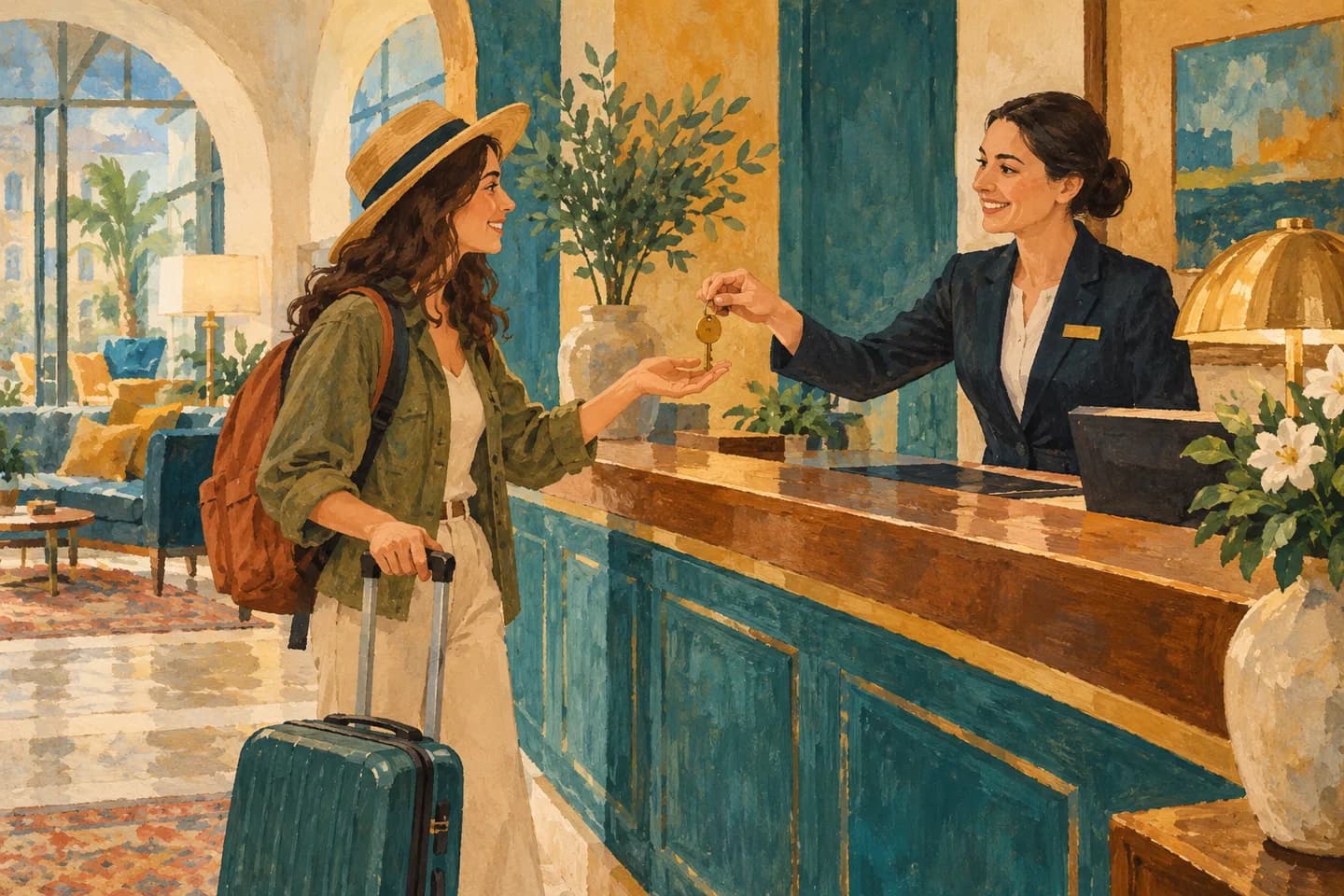
You can say tengo una reserva perfectly and still miss the next sentence. At hotel reception, the difficult part often comes after your opening: the surname, the floor, the breakfast hours, or the instruction to leave a deposit.
Practice the whole exchange before your trip. This guide gives you a short, adaptable conversation and a way to check that you understood the details that affect your stay.
Start with the reservation, then pause
Buenos días. Tengo una reserva a nombre de Taylor means 'Good morning. I have a reservation under the name Taylor.' Replace the surname with yours; keep a copy of the confirmation available. A nombre de is a useful phrase to learn as a unit.
Reception may ask ¿Me puede dar su pasaporte? ('Can you give me your passport?') or ¿Tiene algún documento de identidad? ('Do you have identification?'). Requirements vary by hotel and country, so the dialogue is language practice, not a statement of check-in policy. Listen for the document being requested before handing anything over.
For an evening arrival, buenas tardes or buenas noches may fit better. If you are unsure, hola followed by the reservation sentence is a straightforward opening. You do not need a long introduction to explain why you are standing at the desk.
A complete exchange you can rehearse
Guest: Hola. Tengo una reserva a nombre de Taylor. ('Hello. I have a reservation under Taylor.') Reception: Sí, para dos noches. ¿Me puede dar su documento de identidad? ('Yes, for two nights. Can you give me your identification?') Guest: Sí, aquí tiene. ('Yes, here you are.')
Reception: Su habitación es la doscientos catorce, en el segundo piso. ('Your room is 214, on the second floor.') Guest: ¿El desayuno está incluido? ('Is breakfast included?') Reception: Sí, de siete a diez, en la planta baja. ('Yes, from seven to ten, on the ground floor.')
Guest: ¿Dónde está el ascensor? ('Where is the elevator?') Reception: A la derecha. ('On the right.') Guest: Gracias. ('Thank you.') Read each role aloud, leaving a small gap before the response. These are invented practice lines; a real receptionist will choose different words.
Ask the question that changes your plan
¿A qué hora empieza el desayuno? asks when breakfast starts. ¿A qué hora termina? asks when it finishes. Memorizing both lets you recover a missing detail without requesting the entire explanation again.
Included and available mean different things. Está incluido tells you breakfast is part of the booking. Hay desayuno tells you that breakfast is offered. If the price remains unclear, ask ¿Cuánto cuesta el desayuno? ('How much does breakfast cost?').
Room and floor vocabulary varies. Habitación is widely useful; cuarto is also common in several places. You may hear piso, planta, ascensor, or elevador. Check the hotel's signs instead of assuming a floor label follows the numbering convention you use at home.
Recover politely when the numbers run together
Perdón, ¿puede repetir el número de la habitación? means 'Sorry, can you repeat the room number?' For a speed problem, try ¿Puede hablar un poco más despacio? ('Can you speak a little more slowly?'). These requests use the polite usted form.
Confirm one detail: ¿De siete a diez? ('From seven to ten?'). A brief repeat gives the other person something specific to correct. If you understood ten but missed seven, ask ¿A qué hora empieza? rather than restarting the conversation.
Avoid storing sensitive booking details in a practice recording. Use a fictional surname and room number while rehearsing; keep your passport number and payment information out of language exercises.
A five-minute check-in drill
Read the answer before deciding breakfast is included
Use this second, invented reception card after the main dialogue: 'Su habitación es la trescientos doce. El desayuno no está incluido. Cuesta diez euros y se sirve de ocho a once.' It says room 312; breakfast is not included; it costs ten euros; service runs from eight to eleven. These are exercise details, not a real hotel's prices or policies.
The tempting mistake is to catch desayuno and the hours, then assume the meal belongs to your booking. The word no reverses that decision. A useful reply is 'Entonces, cuesta diez euros y termina a las once, ¿verdad?' ('So it costs ten euros and finishes at eleven, right?'). This repeats a price and an end time instead of merely saying sí to information you have not checked.
Now remove 'Cuesta diez euros' from the card. You still know breakfast is not included in the booking, but its price is no longer stated. Ask '¿Cuánto cuesta?' rather than carrying ten euros over from the earlier version. Record facts as confirmed, missing, or corrected; a blank is more accurate than a remembered answer from the wrong rehearsal.
Apply what you read · no account needed
Check your understanding
Extract inclusion, price and hours from a changed hotel reply without importing facts from the first dialogue.
Use it in a different situation
Write a fictional check-in card with a room number, breakfast inclusion and hours. Have a partner omit one detail; ask only for that missing detail and repeat the corrected answer.
This is a self-check, not a language-level assessment. Your answers stay on this page and are not sent to our server.